Monobloc vs Split Heat Pumps — A Side-by-Side for Cambridge Homes
Last reviewed: 2 October 2026
A side-by-side comparison of the two main types of air-to-water heat pump, and which tends to suit Cambridge's terraces, flats, listed buildings and frosty winters.
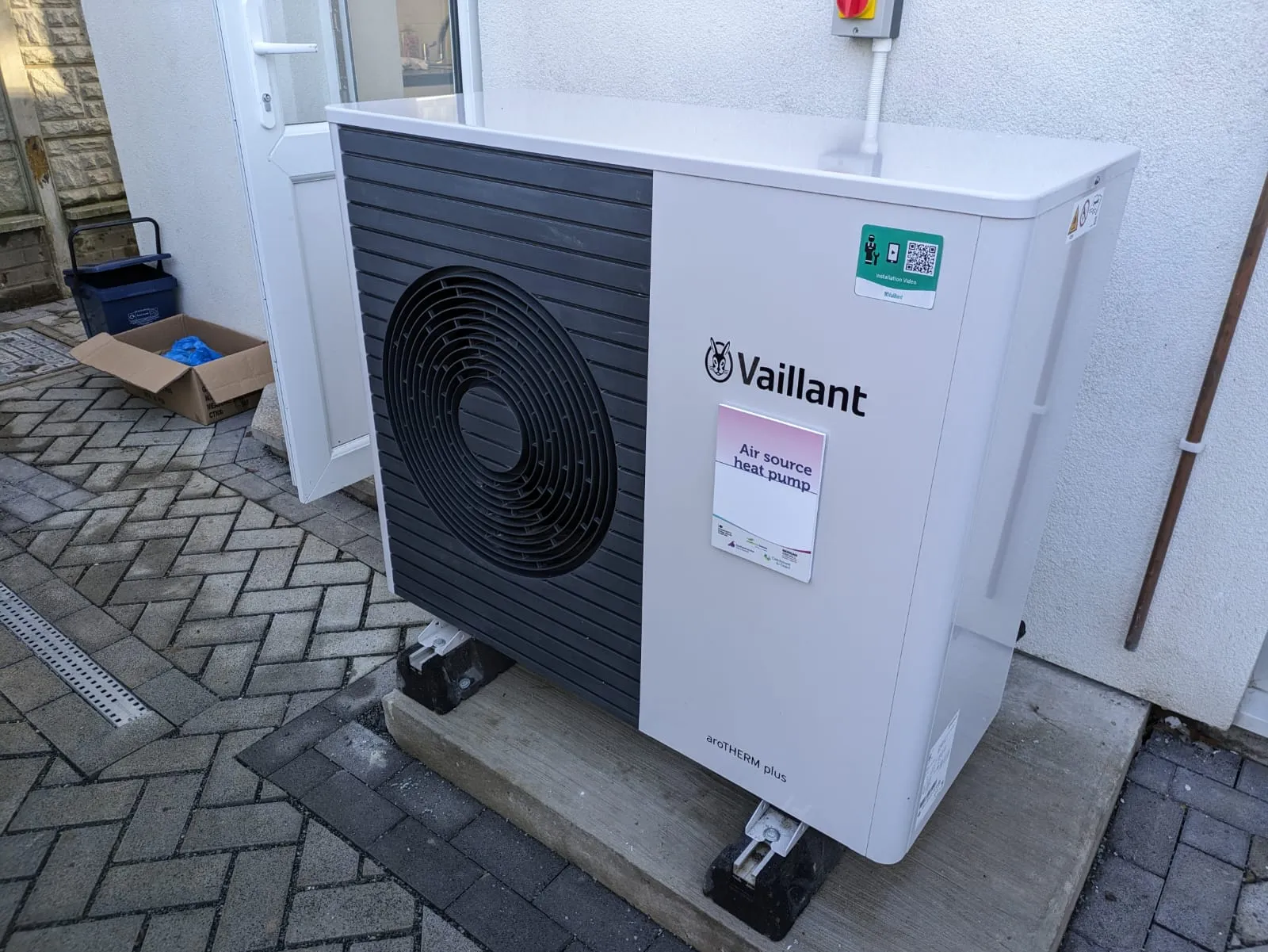
Side by side
| Monobloc | Split | |
|---|---|---|
| Where the refrigerant goes | Stays sealed in the outdoor unit | Piped between outdoor and indoor units |
| What enters the house | Water pipes | Refrigerant lines |
| Outdoor unit size | Larger | Smaller |
| Indoor equipment | Cylinder and controls | Cylinder, controls and an indoor unit |
| Frost protection | Needed for outdoor water pipes | Not needed for the pipes |
| Installer requirement | Heat pump installer | Plus F-Gas certification for refrigerant work |
| Typical refrigerant | R290 or R32 | Usually R32 |
| Typical cost | Lower | Often higher |
| How common in UK homes | Most installations | A minority |
Why monobloc dominates
A monobloc arrives factory-sealed, so nobody has to open a refrigerant circuit in your garden. Installation is simpler, cheaper and quicker. Many monoblocs now use R290, a natural refrigerant that keeps efficiency up at higher water temperatures — handy for solid-walled Cambridge homes where every radiator can’t be enlarged.
The trade-off is the bigger outdoor unit and water pipes that run outside, which need frost protection.
The frost question in Cambridge
With around 52 air-frost days a year at the NIAB weather station, frost protection isn’t an afterthought here. A monobloc installation protects the outdoor water pipes either with anti-freeze valves, which dump water if the pipes approach freezing during a power cut, or with glycol in the circuit. Ask which your installer uses, and keep outdoor pipe runs short and well insulated.
A split system sidesteps this, because only refrigerant runs outside.
When a split makes sense in Cambridge
- Small rear yards in Romsey, Petersfield and Newnham Croft, where a compact outdoor unit is easier to fit and to keep within the 37 dB noise limit at a neighbour’s window.
- Flats, where a smaller outdoor unit is more likely to be acceptable to the freeholder and planners.
- Listed buildings and conservation areas, where a less conspicuous outdoor unit may help consent.
- Long distances between the best outdoor position and the house.
For a typical 1930s semi in Chesterton or Cherry Hinton with a garden, a monobloc is usually the straightforward choice.
Grant position
Both qualify for the £7,500 Boiler Upgrade Scheme grant (or £9,000 replacing oil or LPG, on applications until 31 March 2027), because both heat water. Air-to-air units are a separate category at £2,500.
What to ask
- Monobloc or split, and why for my house?
- How will outdoor pipework be protected from frost?
- What refrigerant does the unit use?
- Where will any indoor unit go?
Related: air source heat pumps in five minutes · Cambridge planning rules
See what a heat pump would look like in your Cambridge home
The mechanism is the same in every UK home; the design is specific to yours. Our team carries out a free in-home survey including a full room-by-room heat-loss calculation, identifies the system size and configuration that fits your property, and provides a written quote with the £7,500 BUS grant already deducted.
You'll see the actual figure you'd pay — not an estimate — and the projected efficiency for your specific install.